
A Holy Communion
A Zen meditation for Maundy Thursday

I turned forty the July before I began seminary.
Out of my experience as a thirty-something undergraduate, I kept one eye open for that one professor from whom I would take anything - an experiment in deep learning. I met him at a reception of some sort. He had a dry wit, was frighteningly intelligent, and, something I never expected to encounter in seminary, had a hint of sanctity about him.
For a Unitarian Universalist seminarian at the Pacific School of Religion who had also been a practicing Zen Buddhist for several decades at that point, it seemed mildly ironic he would be a professor of liturgics over at the Episcopal seminary, one of the then nine seminaries at the core of the Graduate Theological Union in Berkeley.
I took a number of classes from Professor Louis Weil. Many more than would be of use to someone going to a UU parish.
Early on I was assigned the task of finding a theologian whose eucharistic theology was interesting. I dug around and ended up writing on the remarkable Bishop Benjamin Hoadley. He was a shameless and enthusiastic Erastian, it was said that Queen Mary once remarked he’d make a perfect archbishop of Canterbury “if only he were a Christian.” But that didn’t interest me. What did was his eucharistic thinking. He advocated a strictly memorialist understanding.
I was taken with that approach, and began to consider the powers of memory as a spiritual act.
This led to a continuing fascination. Of all the rituals of the Christian church the one that most touches me, the one that I most deeply respect, and which I find points into the greatest of mysteries is the Eucharist.
Of the Christian sacraments, the only one that seems to have unassailable scriptural support is baptism. Jesus was, after all, as a disciple of John, first of all a baptist. The only other two candidates were foot washing and communion. Neither seems an obvious shoo in for the hearts and minds of the gathering community of Jesus’ followers in the years immediately following his death. Well, and those persisting stories of resurrection.
Foot washing never took hold. Here and there, and occasional, but never widely thought of as central. I think an argument can be made. But it wasn’t.
And then there’s the Eucharist. The Lord’s Supper. The Mass. The Holy Qurbana. Holy Communion. The Blessed Sacrament.
All three of the Synoptics describe the Passover meal as does Paul in his letter to the Corinthians. Some find a reflection on the Eucharist in Bread of Life Discourse in John’s gospel.
The oldest surviving church manual, the Didache, possibly as early as the first century, and certainly by the early second, states that in order to participate one must be baptized, then before participating one must confess one’s sins and resolve disagreements with others. And notably it calls the eucharist a “sacrifice.”
So quickly the Eucharist is seen as some form of sacrifice, and that it provides spiritual food and drink. Actually I don’t think its until the Reformation that we get any significant numbers of Christians treating it as a memorial. Instead, it has been seen as some living act, and really more, of the union of heaven and earth through the sharing of bread and wine, which is Jesus.
Of the various Eucharistic theories I find the most compelling of these many attempts attempts to put words to the matter, is that Jesus is really present in the elements of bread and wine. After that it’s all following various matters of the heart.
Now, some thirty-four years after my ordination as a Unitarian Universalist minister and a Zen practitioner and Mahayana Buddhist for well beyond fifty years, I find the communion continuing to touch my heart, and to whisper words of wisdom and healing into my being.
I thank Professor Weil, my dear teacher, for pointing me over and over toward this ancient and holy rite.
Today as I expand my reflections of the nondual, the healing mysteries of the not two, the Christian communion sings a deep wisdom into my heart. It does this as a physical thing, as composed not only of words, as important as they are, but also involving bread, Bread is God. Yes, as is Rice. As is any food to a hungry soul. And involving wine, a powerful drug, filled with so many possibilities of healing and destruction.
And it calls for eating.
The meeting of heaven and earth at a table.
My Maundy Thursday meditation…
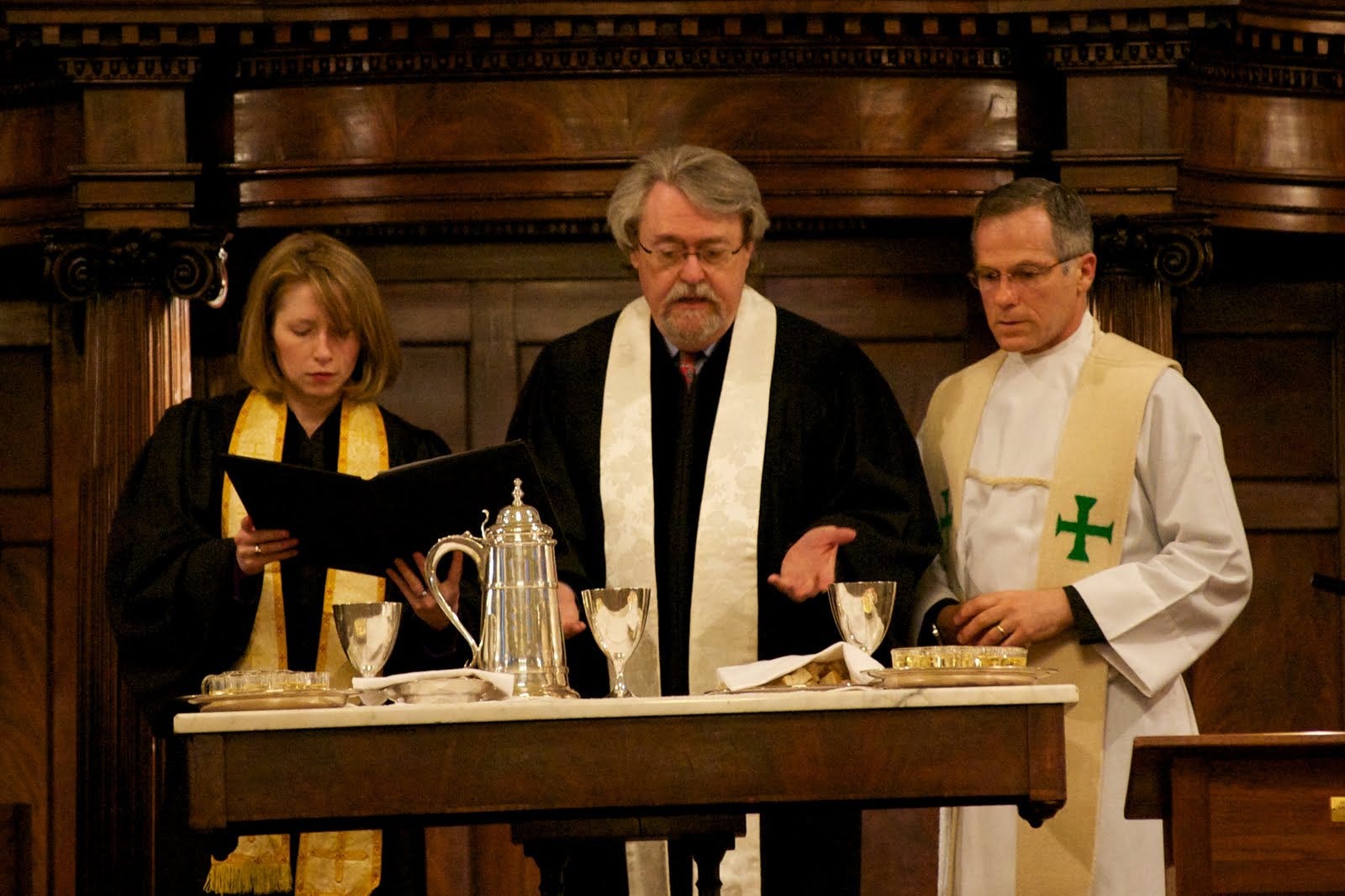
The image is the author and two colleagues celebrating communion at the First Unitarian Church in Providence, Rhode Island.