
Bodhisattva Dreams
Considering the Christian Preferential Option for the Poor in Christianity and Buddhism’s nonduality

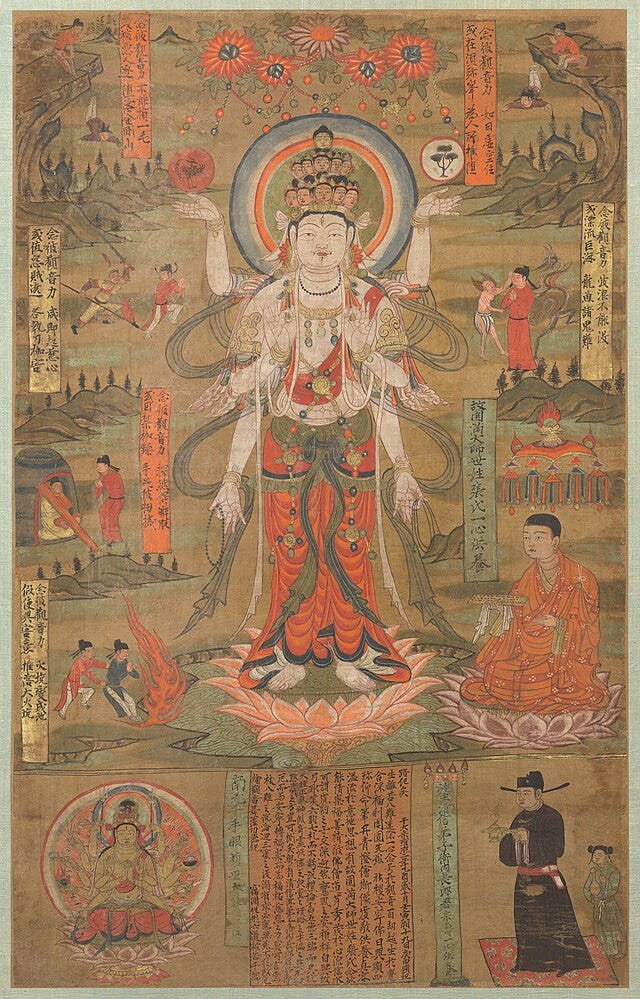
Yunyan asked Daowu, “How does the Bodhisattva Guanyin use all those hands and eyes?” To which Daowu responded, “It is like someone in the middle of the night reaching behind her head for the pillow.”
From Blue Cliff Record, Case 89
For me one of the most compelling contemporary Christian theological concern has been what is called the “Preferential option for the poor.” Concern for the poor is a current that runs through the scriptures both in the Hebrew and Christian parts. This is also found among early theologians, especially in Augustine.
The phrase itself seems to trace to a 1968 letter written by Father Pedro Arrupe, then superior general of the Society of Jesus. It was further unpacked by the Dominican theologian Gustavo Gutiérrez in his seminal 1971 study, A Theology of Liberation.
The word option, in Spanish opción was used to convey a conscious commitment or choice. While preferential was understood to be a special priority given to the most vulnerable.
While highly controversial in this often bloody era of national struggles throughout Latin America, it rather quickly rooted in the Catholic church. The phrase was used during conferences of Latin American bishops in statements calling the church to an “effective preference” for the most needy. It became normative Catholic theology when Pope John Paul II folded it into his 1987 encyclical Sollicitudo Rei Socialis, where he called the option a “special form of primacy in the exercise of Christian charity.” Pope Francis further expanded this understanding by folding environmental justice into that option.
In his wonderful article A Buddhist Critique of, and Learning from, Christian Liberation Theology, scholar and lama John Makransky notes the dualistic shadow. Which is a tendency to “reify a duality between those who are preferred by God and those who are not, a duality that makes it difficult, practically speaking, actually to love each person unconditionally in the way that Jesus taught.”
He notes how more contemporary ecofeminist liberation theology corrects for much of this. He then suggests a Buddhist critique might also be helpful to the Christian community in further clarifying this profound intimation.
While at the same time offering Christian critiques of Buddhism that might prove helpful within the Buddhist community. Specifically, Makransky suggests, “Christian liberation theology …informs and helps reframe Buddhist understandings of compassion and its cultivation, and stimulates new insights into current social implications of ancient Buddhist teachings of karma, interdependence, and bodhisattva practice.”
Something like this runs through much of the work of the late Vietnamese monk and teacher Thich Nhat Hanh. Matt Williams, a member of Thich Nhat Hanh’s Order of Interbeing writes about the adaptation of Liberation Theology to Buddhist concerns. “(T)he preferential option is not about more compassion for one group over another, but about the skillful means that allows us to best understand how to help oppressed people, those who suffer the most—and, in the long run, will also allow us to help those in more privileged positions as well.”
What first called me toward Buddhism was discovering the Buddha’s teaching of a pervasive hurt at the center of our existence. Seeing this was what launched him on his path. My recognizing that led me, step by step, toward a Buddhist life. And quickly into the Zen version of that life.
For the Buddha suffering was framed by the existential questions of sickness, old age, and death. In what feels much like a complementary insight Jesus was concerned with the suffering of oppression. Finding that these are not unconnected, seems very important.
Our suffering is present. It is psychological. But it is also physical.
Hunger is a terrible form of suffering. Being relegated to second or third class status in one’s corner of the world is also a terrible form of suffering.
Buddhism often can be seen as a solitary project and in some sense psychological, certainly deeply personal. But with the rise of the Mahayana this has also of necessity as being seen as social. The Bodhisattva ideal is a vow to not pass beyond until everyone, every being, comes along. And for many schools of Buddhism, especially true in Zen, there is no clear line between sentient and insentient. Everything goes together.
In practice, I see a layering here. At the heart of it is insight and liberation. But it is also intimately connected in a next layering with social hurt. Here we find our liberation caught up together. It includes everything. Like the ecofeminist pointing out of our bodies and the world being bound up together.
We are not two, not precisely. And we are not one, not precisely.
What we are is intimate. This intimacy is something internal. And, very much, it is with and among all the others of this world.
And the call from before the birthing of the cosmos is to a reconciliation.
Our path is one of healing.
This emphasis on the communal part of healing is particularly emphasized in Christianity.
This emphasis brings something really important. As the scholar Paul Knitter writes, “From their experience, from their position of suffering and exploitation, the oppressed can see the world in ways that the powerful or the comfortable cannot.” Being aware of marginalization, of hunger, as primal aspects of our suffering, we are given a great, if terrible gift.
Based on this is a call to the meditator. “The mindfulness we practice on our cushions or in our pews must be balanced and expanded by the mindfulness gained on the streets. In fact, our social mindfulness will have the privilege of correcting our personal mindfulness.”
This meeting of the inner tradition and reaching out in concrete ways is like a box and its lid. However, this is not the end of the matter.
Professor Knitter adds the critical Buddhist contribution to this conversation. ‘If Christians remind Buddhists that personal transformation is incomplete without social transformation, Buddhists in turn will remind Christians that social transformation is impossible without personal transformation.”
There’s an old saying.
Insight without action is a dream.
But action without insight is a nightmare.
How each of us engages this complexity of inner and outer is going to be unique to our situation. Causes and conditions speak eloquently to how we will appear in this world. But, it is all of it, connected.
But the bottom line is our liberation is also connected. And it has several nuances in this world of causes and conditions.
And. Kirtan master Krishna Das, at the request of Zen teacher Bernie Glassman and inspired by the Zen meal chant wrote “Gate of Sweet Nectar.” It seems to me to summarize all of this and where it takes us.
Or can…
“Calling out to hungry hearts.
Everywhere through endless time.
You who wander, you who thirst.
I offer you this Bodhi mind.
Calling all you hungry spirits.
Everywhere through endless time.
Calling out to hungry hearts.
All the lost and left behind.
Gather round and share this meal.
Your joy and your sorrow.
I make it mine.”
https://theologicalstudies.net/wp-content/uploads/2022/11/9-Makransky-The-Buddhist-Critique.pdf
https://www.embodiedphilosophy.com/a-buddhist-christian-liberative-praxis-2/
The illustration of the Eleven Headed Guanyin dates from the Song dynasty, circa 985 CE.
Very helpful. Duality is everywhere. Here the Buddhist and Christian perspectives give each other needed balance. Right now, for me, the temptation is to see Trump, Moore, Epstein, et al as simply (oversimply) those who cause suffering, and not also those who suffer. In a culture that values financial accumulation above every other value, an excess of wealth is a particularly seductive and harmful condition that few can handle. I.e., making someone a billionaire is a cruelty imposed on them, as well as on those who are deprived of the basics as a result of that misallocation of wealth.
Thank you for this rich exploration, James! I really appreciate how you have woven together Christian and Buddhist perspectives on addressing the phenomena of suffering -- not just the internal experience, but the physical experience that unfolds as a result of the inequities so prevalent in many societies.
It was interesting to learn about the origin of the phrase "preferential option for the poor," and I immediately thought of Dr. Paul Farmer and his radical, transformative work in Haiti and other parts of the world. As he clarified his own philosophy and theory of change, he latched onto the phrase and made it the foundation of Partners in Health, the NGO he founded. Those not familiar with Dr. Farmer's work might appreciate reading the book Mountains Beyond Mountains, by Tracy Kidder. Everything you've written about here is exactly what Paul did in his daily life and work, at an unprecedented scale. Talk about walking the talk!