
Heaven & Hell
Zen Buddhism and Christian mysticism in Conversation

In those brief years before adolescence one of my great fears was that my father was going to hell. Everyone else in the family was destined for heaven. But while we all faithfully attended a series of small fundamentalist Baptist churches; he was one of those men who stayed in the car smoking, or more commonly went to a nearby bar until services were over. He was also a scoffing atheist, who made fun of the more unlikely aspects of biblical religion, like the four corners of the earth and a person being swallowed by a big fish.
This would haunt me until sometime in my adolescence, when I left Christianity on my great spiritual pilgrimage. For some years after there would continue a lingering anxiety.
When I became a student of the Zen way I was surprised to learn about Buddhist hells. Pretty awful places, as well. Now they were all temporary, but temporary can be a very long time. In fact there’s a famous story about the great Eighteenth century Japanese Zen master Hakuin Ekaku. When he was eight his mother took him to a lecture, where the priest described the Eight hot hells.
The sermon was part of a theme of popular preaching, usually drawing on the Tendai monk Genshin’s “Ōjōyōshū,” the “Essentials of Rebirth in the Pure Land.” Genshin’s imaginative details of horror then emphasized in those popular sermons terrified the boy. At eight years the length of time in a hell, which could last a very long time. Images for that length of time were little different than images for calculating a kalpa. Such as a massive cube of mustard seeds, where once in a hundred years, someone removes a single seed. One’s time in hell could be longer than that. For an eight-year-old, or for that matter I have trouble distinguishing it from forever.
But it is different.
The normative Christian teaching of eternal hell is probably the aspect of Christianity that’s most resistant to a nondual understanding of the tradition. One can see a metaphysical divide hardening into self-and-other, the ultimate denial of Zen’s “not two.” It becomes the fundamental divide: heaven and hell. And with an unbridgeable gap.
Except, it seems, for Jesus.
In the myths of many religions there are hells. Buddhist cosmology, for instance, posits many hells tailored to individual transgressions. As the young Hakuin found seared into his imagination. However, these hells in the various world religions are almost always temporary, purgative events. Among the major religions of the world only in Christianity and its sibling Islam do we get a doctrine of eternal conscious torment.
How Hell as a place or state of eternal conscious torment became a normative belief in Christianity is not entirely clear. The scriptures are messy, and it’s certainly possible to find an eternal Hell in the Christian scriptures. The Book of Revelation with its Lake of Fire has captured many imaginations over the many years.
Revelation is a monument to allegory, parable, and metaphor that generations of readers have turned into a literal description of future events. And probably more than any other book of the Bible, it becomes the source for people’s belief in eternal conscious torment. The problems with the book as prophecy are why it took a long time for it to be generally accepted into the forming canon. The last book to be included in what have become the normative lists. And to this day there are Christians resistant to its authority.
By the fifth century a normative understanding of Christianity came to the fore, along with some principal minority reports. The majority view was that the majority of people would end up in Hell, a place or state of torment. Most saw a two-step progression, the immediate death of the individual and then at the end of time a general resurrection, a judgement, and a waiting Lake of Fire.
And there has always been resistance to this dualism. The Christian tradition is lovely and considerably more complex than any simple reduction of the tradition might have it. So, like all very important things, it needs to be approached carefully.
A lot of this is built upon the tradition’s understanding of sin. Sin is a word well worth unpacking. It’s the Christian tradition’s angle on the great wound that people have noticed across cultures and time. There is within it a pointing to a facet of the jewel that is our human engagement with hurt. Hell, however, as it is commonly understood, is a worm, eating away at the truths the tradition brings forward for human healing.
That there is an eternal aspect to this understanding of abiding sin, as Buddhism speaks of endlessly arising demons of greed, and hatred, and ignorance; feels important to notice. And definitely for me as a Zen Buddhist looking honestly at Christianity, to not too quickly explain away.
But an intuition of wrongness in sin leading to endless suffering for an individual, a lot of Christians have trouble with it. Another truth. Some Christians feel for theological consistency, there needs to be a Hell; but that no one needs to be in it. Others believe in the annihilation of the unjust. And still others believe some eventual restoration of all to God. There are plenty of potential scriptural citations to prove which ever position one finds intuitively to be correct.
Among the Orthodox and for many other Christians this concept of an eternal Hell as one of two destinations to some place is a fundamental misunderstanding. Most Orthodox thinkers believe that Heaven and Hell are states, and actually are the same expression of God’s love. Heaven and hell are experienced, either as joy or as pain, depending on one’s willingness to accept the eternal gift endlessly presenting.
Love is a powerful and always, always, a dangerous thing. Love heals and it burns. But trying to define it more precisely becomes difficult.
Here’s a dangerous point in considering what hell might actually mean in our lived spiritual lives. I believe it easy to see two directions one might go. Hell represents the ultimate in seeing a dualistic world. While some approach to restoration, reconciliation, is the gift of a nondual perspective. This is the universalist intuition. Here nothing falls outside of the divine. The pursuit of salvation is a discovery of the intimacy offered within the Christian approach. Within God’s love there is no outside, no remainder, no one permanently excluded.
But I think simply pointing out dualism as wrong and offering a “correct” view is only one angle on what can push us to even deeper perspectives. Where I find the most important invitation is letting the two traditions present within their wholeness. And from there to allow them to work out the deeper possibilities, taking us to our true freedom. For Christians, I suspect this is looking for a larger reconciliation. The individual’s eternal suffering is also God’s eternal suffering. And if there’s an original sin, there’s also an original blessing. And so, God’s eternal bliss, is also everyone’s eternal bliss.
As a Zen Buddhist I find some important points, as well. For one thing a kalpa of punishment might as well be eternal from any ordinary human perspective. And then the play of the universe and its many causes and conditions can play out as it will. One Zen master was asked if there were a hell? And responded, yes, and I’m going there. The questioner asked why? And was told, so I can help you.
More than a joke.
When the Zen monk Hakuin entered the monastic life, he told the teacher Shoju Rojin about his bone chilling terror of hell, the young monk was rebuked. He was told that idea was self-centered. And therefore, it was rooted in a delusive understanding of who we actually are.
Another point for all of us on any authentic path. How do we shake off centering ourselves? And can we? And if so, what does it mean?
There’s a story attached to Hakuin. Well, there are several of questionable historical reliability. But for the most part they contain important points. For instance, years later, and now a Zen master, Hakuin was approached by the samurai Nobushige. Nobushige was also troubled by the idea of heaven and hell. Hakuin responded by telling him he wasn’t capable of seeing into the matter. Enraged the samurai started to draw his sword. Hakuin noted how the gate to hell had just been opened. Chagrined Nobushige returned the sword to its scabbard. And, Hakuin responded, how now the gate to heaven had been thrown wide open.
Not that far, I find, from the Orthodox sense of heaven and hell being the same state but met with different eyes, a different heart. I think of this and realize my fear for my father all those years ago, was more about seeing his choices playing out in real time.
And a question arises. What is this hall of mirrors that we’re walking into when Christian mysticism and Zen Buddhism gaze on each other?
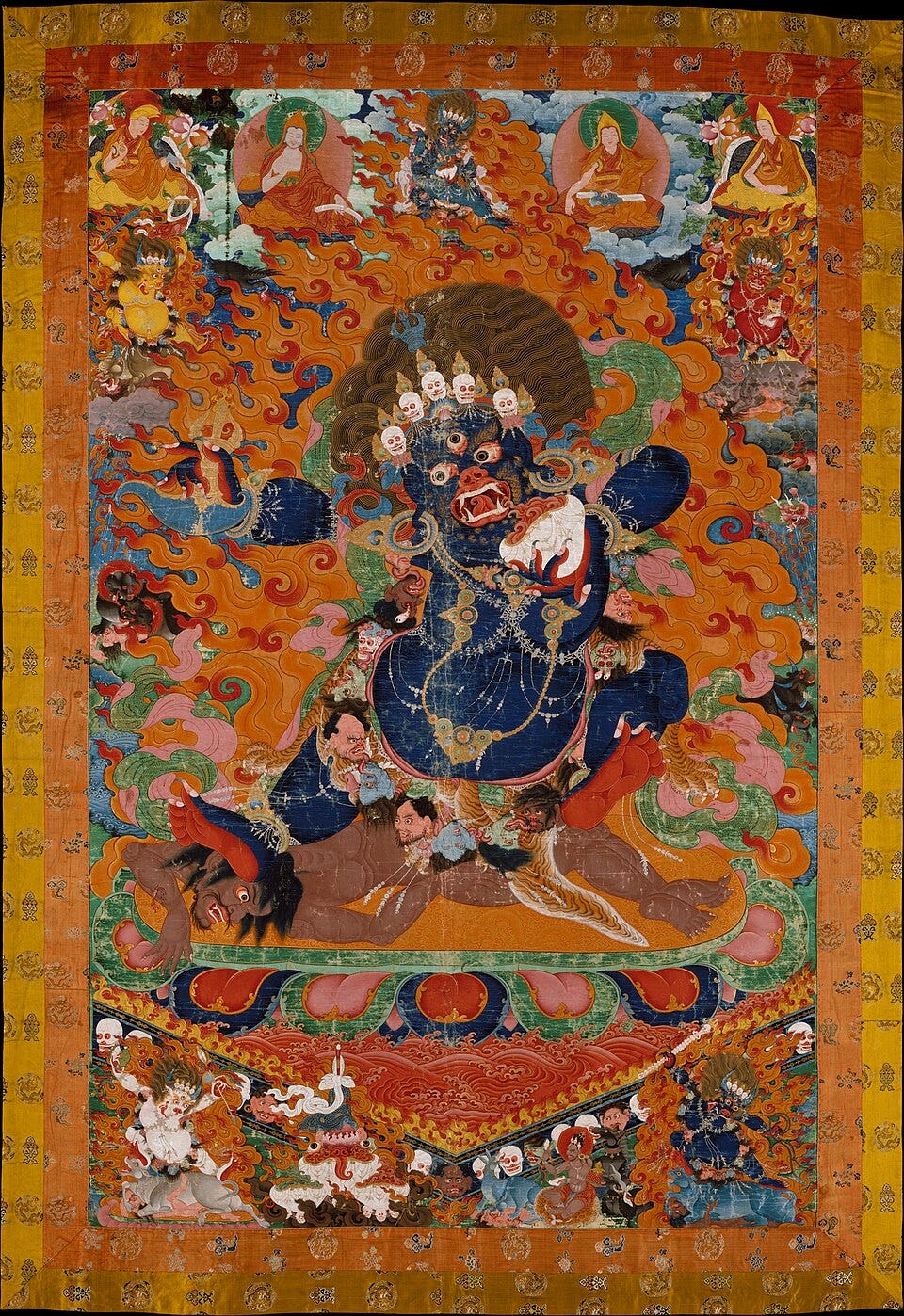
The image of Yama by an unknown artist is from mid 17th to early 18th century, Tibet
What I appreciate here is that hell is not treated like a place we point toward other people. It becomes something closer, more honest, more dangerous: the state of the heart when it meets love and cannot receive it.
That feels very real to me on the path of remembrance. The same mercy that softens one heart can burn another place in us because the nafs still wants control, separation, superiority, or revenge.
The Hakuin story says it plainly. Hell opens in the flash of rage. Heaven opens in the moment of return. That does not make judgment less serious. It makes it immediate. The question becomes not “who else is going where?” but “what is my own heart becoming capable of receiving before Allah?”
The Hakuin and Nobushige exchange might be the cleanest demonstration of something I keep circling: that the gate to hell and the gate to heaven aren't two separate destinations reached by two separate roads. They're the same threshold, crossed twice in one conversation, met first with rage and then with recognition. Nothing about the location changed between those two moments. Only what was meeting it did.