
Nyogen Senzaki
No roots. No branches. Clouds. Water.

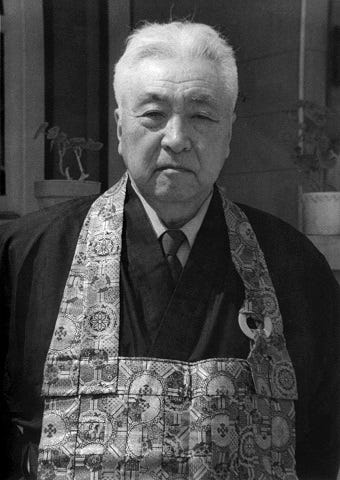
Nyogen Senzaki died in Los Angeles, on the 7th of May, 1958. He was either 81, or perhaps 82.
He referred to himself as a mushroom, having no deep root, no branches, no flowers, and “probably no seeds.” A Zen monastic is called in Japanese an unsui, it means clouds and water. It flows freely, it takes the shape of the moment, an then continues on to the sea or the storm or whatever set of conditions there are that dictate a new shape.
No root, no branches.
Just a lingering memory of connection.
Nyogen Senzaki was a central figure introducing Zen to North America. I wrote about him in my Zen Master Who? A Guide to the People and Stories of Zen. Much of what follows is based in the appreciation I wrote then. But that was a while back and I have added some details.
Not much is known about Senzaki’s early years. He was born sometime in the late nineteenth century in Siberia. His mother was Japanese, his father either Chinese or Russian. Orphaned early on, he was taken in by a Japanese priest and adopted by a shipwright named Senzaki.
He was later taken under wing by a Soto priest who provided him with an education and, it appears, ordained him an unsui.
Clouds. Water.
In 1896 he went to the Rinzai training monastery Engakuji, and became Soyen Shaku’s student. This crossing over of sect, which is fairly unusual today, was at that time virtually unheard of. In those days just to transfer from one teacher to another in the same school led some to cut off a finger as a sign of regret.
He studied with Soyen Shaku for five years, after which he left the monastery to found a nursery school, inspired by the German innovation of kindergartens. Determining to live simply as a celibate. Throughout his life Senzaki tried hard to live as a monk rather than follow the increasingly normative priestly model of Japanese temple life, which included marriage and usually children.
When Soyen Shaku Roshi made his second visit to America in 1905, he was accompanied by the young monk. It seems Senzaki first came to America with the idea of raising funds for his nursery school. But he ended up staying on, first as a houseboy at the home of Alexander and Ida Russell, early supporters of Soen Roshi. Interestingly, Ida was possibly the first Westerner to formally practice koan introspection.
He later continued doing domestic work for others and, for a while, taught English and Japanese. He then began working in hotels, first as a porter and after a time making his way up to manager. He briefly owned a hotel, but when that failed, he became a cook.
In 1922, Nyogen Senzaki hired a hall and gave his first lecture on Zen. This was the beginning of his “floating Zendo,” which he recreated wherever he could hire a hall or cajole a friend or acquaintance into letting him use her or his living room.
He led the itinerant group that gathered around him in various places from San Francisco to Los Angeles for the next thirty years, excluding only the war years. In 1942, he was interned with 10,000 other Japanese nationals at Heart Mountain in the Wyoming desert.
As Zen began to attract Western attention through the books by D T Suzuki, who had also accompanied Soen Shaku together with Senzaki. And then made even more popular by Suzuki’s admirer Alan Watts. A trickle at first, but with the rise of the Beats and especially Jack Kerouac and his novels, people wanted to find a Zen teacher.
He even contributed to that early raft of English language Zen teachings Zen Flesh, Zen Bones. It came out in 1957, and I’m pretty sure it has not gone out of print since. It’s actually the first book on Zen I read. Paul Reps was the principal compiler, but Senzaki’s fingerprints are all over the book. Senzaki compiled and translated with some help from Reps all of the first section “101 Zen Stories.” And his influence flows through the rest of the book.
He also translated the 18th century Japanese koan collection, the Iron Flute, with significant help from Ruth McCandless who completed his work after his death and saw it through publication in 1961.
Critically many Californians and others had their first taste of Zen practice and thought under Senzaki Sensei’s tutelage. This number included the young Robert Aitken, who would go on to be one of the most respected Zen teachers in the West. A close friend of the great Soen Nakagawa, Nyogen Senzaki also became a mentor to Eido Shimano, credited as an important teacher, but also it turned out, a sexual predator.
But that was later, we’re at the very beginning when talking of Senzaki.
As I noted at the beginning Nyogen Senzaki died in 1958. Knowing that he was dying, he recorded a message to be played at his funeral. In it he said: “Friends in Dhamma, be satisfied with your own heads. Do not put any false heads above your own. Then minute after minute, watch your steps closely. Always keep your head cold and your feet warm. These are my last words to you.”
But in fact they weren’t.
He then added:”Thank you very much, everybody, for taking such good care of me for so long. Bye-bye.”
Aitken Roshi, who was there, says that at the tail end of the tape the last thing one could hear was a small laugh.
Clouds. Water.
In one sense Nyogen Senzaki really was a mushroom: he left no Dharma heirs. (Well, there are some who say they were. As he had no formal authorization himself and there are no written records that I’m aware of where he says he gave his authorization of no authorization to others, it’s all a bit cloudy...)
That said. Thanks to his early books on Zen, and all those halls he hired, and his floating Zendo, much of Zen on the West coast of North America got its start.
So, this week I’ll be lighting incense and reciting the Heart Sutra for this venerable, this ancestor of our emerging western Zen community.
No roots. No branches. Clouds. Water.
Endless bows…