
Reading and Writing
The emergence of a Western spiritual practice

There’s a contemporary spiritual practice engaged by a lot of my friends. It mostly seems to have emerged along with the arrival of a new form of spiritual direction. What we mainly meet today with that term, where someone undergoes a period of training, reads a lot, experiences a number of practices, and then works with people in a sense similar to counseling or coaching.
One practice has caught my attetnion. Or, maybe it’s two. For me they seem entertwined.
The first is Lectio Divina. That’s Latin for divine reading. It is defined originally as prayerful reading of the scriptures.
Those who admire the Lectio often place its origins among the Desert Mothers and Fathers. And there certainly is something to it. One practice that arose among them is Melete, a Greek word meaning “care” or “attention” or even “practice.”
John Cassian, who died in 435, captured the sense of this practice in his Conferences (Conference 10, chapters 10 & 11). In the Conferences he captured the teachings of a number of monastics at Scetes, one of the three great monastic centers of the Desert Fathers and Mothers.
He quotes Abba Isaac describing the practice of melete. He used an example of a child learning to read by tracing the letters of the alphabet and pronouncing it until it is firmly place in the heart, there is a spiritual foundation assisting on the path to continuous recollection of God.
He advised taking a line from Psalm 70, “Oh God, make speed to save me: Oh Lord, make haste to help me.” And then to hold it as a constant.
In Edgar Gibson’s translation.
“Whatever work you are doing, or office you are holding, or journey you ar going, do not cease to chant this. When you are going to bed, or eating, and in the last necessities of nature, think on this. This thought in your heart may be to you a saving formula, and not only keep you unharmed by all attacks of devils, but also purify you from all faults and earthly stains, and lead you to that invisible and celestial contemplation, and carry you on to that ineffable glow of prayer, of which so few have any experience. Let sleep come upon you still considering this verse, till having been moulded by the constant use of it, you grow accustomed to repeat it even in your sleep. When you wake let it be the first thing to come into your mind, let it anticipate all your waking thoughts, let it when you rise from your bed send you down on your knees, and thence send you forth to all your work and business, and let it follow you about all day long.”
Some see the origins of the Jesus prayer in this, as well. From a Buddhist perspective it is easy to see something akin to the Nembutsu practice of Shin Buddhism.
The idea behind it is to find an integration of prayer and daily life, labor, and other duties. So, the practitioner murmurs the prayer intending it to occupy the mind throughout the day. Melete seems a translation of the Hebrew hāgā, which means to sigh, muse, or murmur. With this inspiration the practice of Abba Isaac and the Desert Fathers and Mothers take a passage of scripture as a practice.
From here we see this sense of a slow and ruminative engagement with scriptures gradually taking shape. Origen, Ambrose, and Augustine all allude to this kind of engagement in their writings. In the 530s Benedict names lectio divina as one of the three primary practices of monastic life, alongside liturgical prayer and manual labor.
But it isn’t until the Middle Ages we see a clear description of the practice. The French Carthusian monk Guigo II in his Scala Claustralium, the Ladder of Monks, describes the four rungs of a ladder.
The first is Lectio or reading. This is that slow and attentive reading of a short passage of scripture. Guigo warns that in this reading one is seeking spiritual nourishment. And like with eating, it’s wise to take small bites.
The second is Meditatio or meditation. Here we see that sense of melete taught by Issac and the Desert Fathers and Mothers. Again using an eating metaphor, it’s like “chewing” than what most might mean by meditation today. The passage is actively engaged with both memory and attention. This allows inner meanings to emerge.
The third is Oratio or prayer. Out of that emerging sense one finds through meditation a sense arises. This might be a longing, it might be contrition, it could be praise. It’s the response of the heart. This is the end of what human effort can be.
And with that, the fourth rung is Contemplatio or contemplation. It is resting in God. It is a place beyond images or concepts or words. This comes only as a gift, in that sense from John, the spirit rests where it will.
While the language is different this path is not completely unlike my experience of Zen practice. At least in this sense. There is what I can do. Like holding my body in an attentive way. It is noticing my breath. It is staying for a set period of time. Those things. But what happens, as one of my teachers said, is none of my business. Awakening is like being hit by a bus. He added, but those practices do make you accident prone. In a Mahayana sense this is where self-power becomes other-power. Or, more properly, perhaps, where it’s no longer clear who or what is in charge.
Others like Bernard of Clairvaux in his Sermons on the Song of Songs offer similar approaches to the inner life. And importantly Hugh and Richard of the Augustinian abbey of St Victor in Paris begin to build a mystical theology integrating these practices with a deep Neoplatonism. This is for the most part the nondual thread of Christian mysticism.
However, over time from here there comes a shift. I’ve heard it described as a move from monastery to university. The spiritual discipline becomes an intellectual enterprise. The older sense of this sacred reading survives in some monasteries, particularly among the Carthusians. But for the most part concern with reading scripture largely mutated into analysis, resolving contradictions in the texts, and finding support for debate. This trend culminates in the Reformation where scripture becomes more about supporting doctrines of one sort or another, or, at best as private devotional reading.
Then in the middle of the twentieth century there’s a revival of interest in ancient spiritual practices. Thomas Merton serves as an inspiration for both students of Buddhism and for Christians. I see him as a linchpin figure, both literally, and as a type of something happening. Merton’s broad and generous interest in the world’s approaches to the deep matters, inspires people looking at monasticism and at claiming an inner life in the midst of living in the world.
Merton enters monastic life in 1941 and is serving as novice master when Vatican II begins in 1959. The council serves as a revolution within the Catholic church, but it’s influence extends well beyond that particular church. While Merton anticipated some of what would come, he was in many ways both liberated and served as an example of the open doors of that council. And the zeitgeist of that moment.
Here young people and not so young turned to the East in significant numbers. Hindu and Buddhist practices captured many imaginations. Some traveled to India, southeast Asia, and Japan. Many became adepts at the various meditative disciplines, and some were authorized as teachers of those practices.
And both inspired by and in reaction to this, many Christians wanted to dig deep into their own traditions for their practices.
Pioneers in presenting Lectio as one of those reclaimed practice, especially engaged outside the monasteries were from monks like the Cistercian monks Basil Pennington and Thomas Keating. They weren’t the first. For instance the Benedictine monk Jean Leclercq established much groundwork for this particular engagement. Nor would they be the last. But they were pivotal in this revival.
Of course, I think it fair to say of course, this engaged meditative reading has always had a place beyond the focused discipline within the Hebrew and Greek Scriptures. For a long time people saw value specifically in engaging poetry. The psalms themselves are poetry, and it’s a short step into poetry not confined to the canon. The approach of the Lectio is poetic. And so we see things like Bernard’s comments in his Sermons on the Song of Songs are themselves literary and poetic.
Medieval commentators already were noting the “Book of Scripture” is complemented by the “Book of Nature.” So, Hugh of St Victor, as an example brings this expansive approach into his writings. In Nineteenth Century America, the Transcendentalist movement within Unitarianism was explicitly a broadening of what scripture might be. They looked to the newly translated texts of the world’s religions, as well as to nature as sources of genuine inspiration.
And then in the twentieth century there is a flowering of this approach. Perhaps the earliest extension of the specific disciplines of Lectio into secular writings comes with the Benedictine monk David Steindl-Rast. Another Benedictine, the nun Macrina Wiederkehr led retreats that inspired a lot of people in spiritual direction networks. And perhaps Christine Valters Paintner has been the most systematic in this broader engagement of Lectio.
And then there’s writing as a spiritual practice. Especially writing poetry.
Gregory of Nazianzus was an archbishop of Constantinople in the late fourth century and so before the use of the title Patriarch or Ecumenical Patriarch, and more importantly is counted as one of the three Cappadocian Fathers. Okay, there’s a mother, Macrina, as well. Not only was she Gregory of Nyssa’s sister, but many scholars would say, his teacher. But you know; patriarchy. Among many other things Gregory, is arguably the godfather of writing and specifically poetry as a spiritual practice.
His confessional poem Peri tōn idiōn stichōn, sometimes translated as “On His Own Verses,” and sometimes translated as “Concerning His Own Verses,” was written late in his life, is both his justification for his writing poetry as well as an outline of how to do it. He outlines four points.
First, is how it is a discipline. Gregory did his writing for the most part in either Didactic Hexameter or Iambic Trimeter. Much of our contemporary poetry is one form of free verse or another. While the archbishop might not approve, it does bring discipline. Sadly, I know of people who arrange prose on a page as if it were poetry. And it usually for the reader it falls flat. Free verse as poetry has a musicality about it. This is achieved with alliteration, assonance, and repetition.
Second, It’s reflective. As Gregory said, in Peter Gilbert’s rendition, putting “my own afflictions into verse.” But it is also a “cheering medicine.” It is as much for the reader as the writer. He put more emphasis on the didactic element, but I think that bringing one’s deepest into words is also critical. It becomes a mirror, and it is possible with discipline and guidance from true friends to see what obscures that mirror.
His third point is more of his time. Offering the teachings in a way accessible to the reader of the day, for whom verse is entertainment. He probably would approve of using contemporary forms of media to expound the way. If disciplined, if pointing to the deep, even if “sweetened.”
The fourth returns us to its greatest value. Gregory calls it “consolation.” Here poetry and prayer are one. Or, from my Zen perspective, perhaps it would be better to say poetry and prayer are not two. In poetry every word matters. It’s distilled. As he says it’s not “overstuffed.” It points directly. It invites intimacy. Here he calls us back to the discipline of this project. It is the writing of poetry as prayer itself.
Here I find a congruence of two traditions informing a contemporary practice of spiritual reading and writing.
Probably the most important figure for spiritual writing, especially poetry, in our contemporary context is the Jesuit poet Gerard Manley Hopkins. I find something important in Hopkins’ use of the terms, “inscape” and “instress.” These are expanded from the medieval philosopher Duns Scotus and I believe rooting even deeper into the Neoplatonic mysticism of Christianity. As I understand this from my Mahayana perspective, they are Hopkins’ sense of how the causes and conditions of the universe coalesce into the unique individual, and the individual’s sense of others in the same condition. With that his poetry and perhaps ours, attempts to perceive or intuit the “haecceitas,” the “thisness” of things.
Another important figure for me is T. S. Eliot. To what degree he was informed by Lectio or even Gregory of Nazianzus I have no idea. But he was traveling in similar territory. And his influence is wide. Similarly, this broad sense of poetry as a spiritual discipline appears in Thomas Merton, Ranier Maria Rilke, Frederico Garcia Lorca, Jessica Powers, and of course Mary Oliver, and Rumi, to begin what quickly can become a long a list.
Merton particularly explores drawing poets like these into one’s contemplative practices. This practice begins to be given a structure with people like Macrina Wiederkehr and Christine Valters Painner. A critical step along the way.
And now, with the rise of the contemporary spiritual direction movement, we find a full flowering of a spiritual discipline: reading and writing, especially poetry, as twin pathways into the deep.
The challenge in these practices is tumbling fully into subjectivity. Especially if the practice is outside of a traditional context, like their origins within monasticism. Reading and writing are spiritual disciplines that are intimately personal. My advice is the discipline is best exercised within a context of some sort of accountability, not for “good writing,” but for holding ourselves accountable in our exploration of our own depths. This is a spiritual practice. Its purpose is to help us move ever closer to the deep, to the true. God is the word used for this in the west. And so, I suggest having a competent spiritual director, formal or informal, is important.
That said, this reading and writing as spiritual practices are a fascinating invitation into creative contemplation.
And feel an authentic path into the deep, taking us to the face of God.
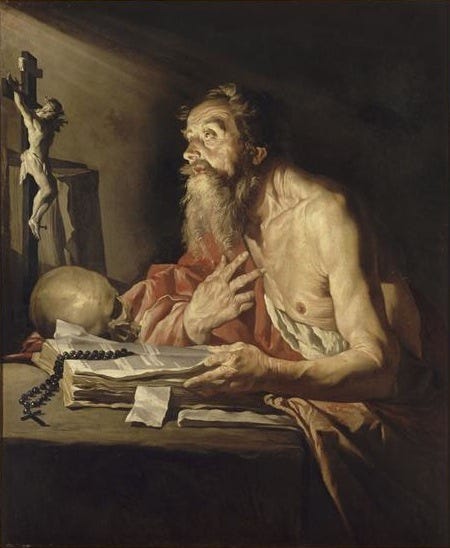
The painting of St Jermone is by Matthias Stom, from the first half of the 17th century.
What a wonderful pulling together of many traditions, and the purpose and history of lectio divina. Right up to the current use of modern poetry as an invitation into our relationship with God. As one who offers exactly this practice in a nondenominational setting, I thank you.