
Sacred and Secular
A meditation on using a spiritual practice for another purpose

For awhile now I’ve been having difficulties sleeping. It’s annoying. For much of my life its been head, pillow, sleep. Whether this is something temporary or permanent, this my life now.
A large part of this is no doubt stress. Caring for someone in hospice can do that. And in our particular case my spouse’s mom seems to have found a stasis point, where hospice actually stabilized her. We’re now pushing toward seven months in this particular liminal place, and no end in sight. And no strong desire for it to change. Not consciously. And. There’s also age. Turning 78 in a few weeks has brought with it endless interesting changes. And, goodness knows, what else into the mix?
Now as a spiritual director within the Zen tradition, I’ve counseled many people that the spiritual should not be a denial of the physical or psychological. And when needed, to seek help in the medical or psychotherapeutic. This is in no way a contradiction from being on the path of liberation.
However, I’ve also had a low opinion of how spiritual practices are commodified and turned into recipes for relaxation. I will not elaborate as I didn’t bring my soap box.
But here I am. And my experience right now of needing help is embarrassing. Despite fully knowing otherwise, somewhere in the recesses of my heart I actually think that, no, this is a shortcoming, a weakness. A failure.
Something in that neighborhood.
I have a couple of small sayings that remind and guide me, “stupid human tricks” is one. Always good to notice and to name. Another is “ordinary dukkha,” which evokes a slightly different set of issues.
And here it all is. On full display. Both of them…
Noting that, and, in case you’re worried, yes I am seeking professional assistance.
But, there has been something I’ve been doing on my own for a while, which sparks this particular reflection.
At night I’ve incorporated a mantric practice as a sleep aid.
Which opens a whole new can of worms.
I’ve tried to be polite when speaking about people appropriating spiritual things to secular uses. Like using mindfulness to calm one’s nerves. But in my heart of hearts I don’t really approve. Note the commodification line…
There is the great goal. And there’s everything else.
Misappropriation, is the word that hangs.
But what I’ve told so many other people is the truer thing. No one is exempt from living in this world as it is and as we are. The long play of causes and conditions are our existence. And here I’m trying hard to listen to my own advice. We are not one and we are not two. We live in both worlds, the spiritual and the mundane. And there is no easy or ultimate separation.
And the mundane that play of causes and conditions do their thing.
And desperate times call for desperate measures.
So… A sleep aid drawn from spiritual practice.
The practice I’ve used as my sleep aid for about a year now has been the Jesus Prayer in its longer form. “Lord Jesus Christ, son of God, have mercy on me, a sinner.” I’ve used the shorter and older version without “a sinner,” but ultimately did the whole thing. Every night. For a year now.
It has had positive effects. It has helped me to fall asleep. And the really hard part for me, when I wake up in the night, it has helped me tumble back into sleep. So, I’ve been enormously grateful.
And I’ve felt guilty about this for a couple of reasons. First the embarrassment of appropriation and the sense of the easy slide into misappropriation. That misuse of a spiritual practice. It’s a real thing. And the Jesus Prayer is not about sliding into sleep.
But there’s another thing. The Jesus Prayer is also not exactly within my actual lived spiritual life. I have more than a passing positive feeling toward Christianity. It is my natal tradition and I have long since burned off my resentments for its negative aspects in my upbringing. I sometimes say that the Bible world lives in my heart. I certainly, and freely use the language of the scriptures. And in many ways they use me, framing how I think and talk. I’m even called a Zen Christian on occasion by observers of my writings.
But in a shove come to push I am a Zen Buddhist. A friend described me as a Zen Buddhist who loves Jesus. But there’s a bottom line in there. I am a Zen Buddhist. The way I frame the distinction is that my brain is Buddhist. Digging into it I fit more or less into the “modernist” version of the tradition with a heavy lean into “naturalistic.”
There are some significant caveats to that box, but the details are beyond the necessary scope for this reflection. Bottom line I try to be honest to myself and my tradition. And that said, Zen is where I live. It is where my practice life is. I am a person of the Zen way.
Beyond the questions of what is my tradition, there is an interesting point. I’m also mindful that those who actually live with the prayer as their lifelong and daily practice, those following the Hesychast tradition, if I understand this correctly; intentionally use the Jesus Prayer to lead into sleep. They trust the prayer will continue within their hearts through the night. A point I hear.
All that said, for a while now, I’ve been trying to find a Buddhist practice that might be adapted into my sleep aid.
My daily practice is a form of shikantaza. Shinkantaza is a term associated with the thirteenth century Japanese Zen master Eihei Dogen. It’s the Japanese pronunciation of the Chinese term zhǐguǎn dǎzuo, which is usually rendered into English as “just sitting.” My version of this practice is what the American Zen master Robert Aitken sometimes called “shikan-mu.” Mu is a koan that invites us to the vast emptiness. A term itself I won’t try to unpack for this piece. But, putting this all together my practice is one of inviting presence, or active presence. It’s an engaged, active surrender into just this.
This practice is raised constantly in my formal sitting, and also carried out into daily life. At this phase of my life it’s something I slip into and fall out of throughout the day.
And I’ve not found it helpful when trying to sleep. It feels more awakening in the sense of keeping me from wandering into sleep. Over this past year I’ve just not been able to bridge into “just sleeping.”
I don’t know what the “should” of this should be. In my life it’s a fact on the ground.
So, I’ve been seeking a mantra I might use as the sleep aid other than the Jesus Prayer. Mantras are not used as a formal practice in my school of Zen. The Obaku Zen school does use the Nenbutsu, “Namu Amida Butsu.” I’ve tried it, but it hasn’t resonated. Possibly because for me Amida and Jesus kind of collapse into each other. But the weight seems to go to Jesus.
For about ten days I’ve been trying on something different. I’m using the Mahamantra that concludes the Heart Sutra: “Gate gate, paragate, parasamgate, bodhi svaha.”
It is both a mantra, a sacred word, and a dharani, a sacred phrase often considered an epitome of a spiritual assertion. In this case vast emptiness. Max Müller rendered the mantra into English as "Gone, gone, gone to the other shore, landed at the other shore, O wisdom Svaha!” Red Pine renders it “Gone, gone, gone beyond, gone completely beyond, enlightenment, so be it.” While Kaz Tanahashi and Joan Halifax rendered it “arriving, arriving, arriving all the way, arriving all the way together: awakening Joy!”
The Heart Sutra and with it that mantra are pretty much a daily experience for me and has been for decades. It’s part of my practice tradition. In the Zen schools the Heart Sutra is chanted every day. And frequently more than once.
However, the mantra/dharani is not separated out and used on its own. The only exception I can think of is how some Western Zen schools, following, I’m pretty sure, Thich Nhat Hanh, when chanting the Heart Sutra, repeat the phrase three times. That’s kind of it.
I thought maybe this is it. So, I did a little digging.
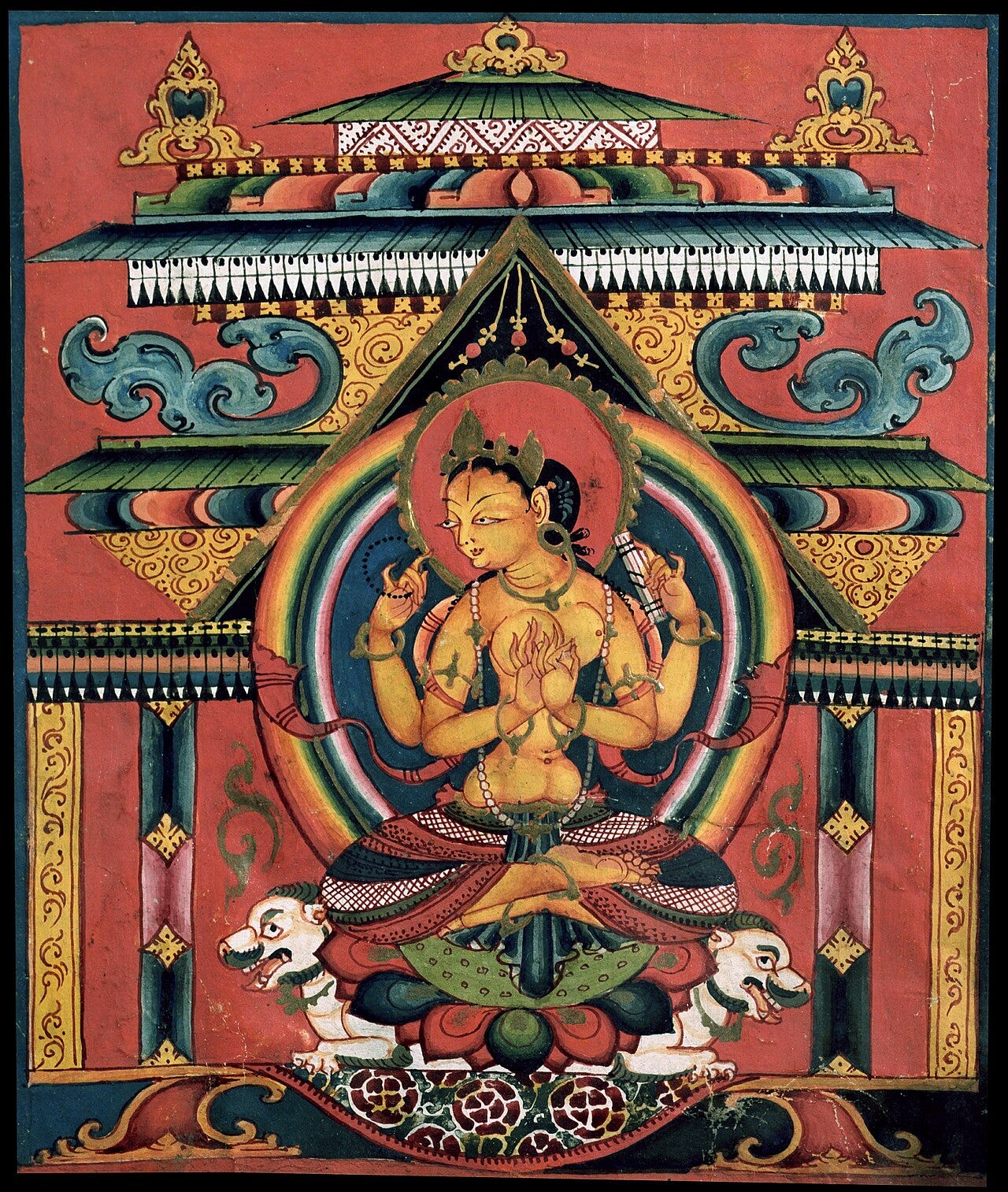
It is used as a mantra in devotions to Prajanaparamita, mainly in the Vajrayana schools. For me Prajnaparamita, the “Perfection of Wisdom” is a theological term, addressing the wisdom way of vast emptiness. It is the name of the body of literature of which the Heart Sutra is sort of a summation. But in the Vajrayana it is also personified as the mother of the Buddhas. She is commonly depicted as a golden figure, with four arms, and holding a scripture and a lightning bolt.
That resonates.
And for a while it’s been an easy slide for me, at least, from my daily discipline into my needful sleep. It’s not a complete fix. The Jesus Prayer pops in when it wants. But it is deeply helpful. And so far, so good.
In the Vajrayana version the mantra is often prefixed with Om or Tadyatha which means something like “like this” or “thus.” I use the phrase without these additions, untranslated from the Sanskrit as it is almost always done.
Gate gate, paragate, parasamgate, bodhi svaha.
I figured I’d place it on the out breath. Breathe in, and then as I exhale, think, Gate gate, paragate, parasamgate, bodhi svaha. And then repeat as needed.
The first night I saw tying it to breathing was a bit too complex. I can do it easily enough sitting up, but laying down it’s too long for my natural breathing patterns. In those waking moments I tried to adjust. First, I repeated “gate.” Interesting but it felt too short. Then I found “Bodhi svaha.” And it felt pretty useful.
I ended up fluxuating in my waking periods between the full mantra and the concluding phrase. When I’m awake enough, I tie the Bodhi svaha to my breath. That breathe in and then exhale Bodhi svaha.
What I didn’t expect is the the deity made something of a visit. Visualizations are not part of my practice life. But there it happened. On the second night I tried using the Heart Sutra mantra she popped for a visit in that liminal space between wakefulness and sleep.
Not fully formed, but there. Golden body. Two arms resting with her hands in her lap, for me in the standard zazen posture. One arm holding a large book open in her hand. While the other held lightning. Not the vajra of the official image, but actual lightning.
Her eyes were cast down in meditation.
It lasted as long as it lasted. In the meantime I was repeating the mantra, either the full thing or that concluding bit.
Then.
I’m also very fond of Guanyin as an archetype. And somehow they flow into each other. At least they do in my heart. And, so, “Namu Kanzeon Bosatsu” has begun to take over as my sleep mantra.
It seems to bring all of together for me. At least in this moment. And least for the last few weeks.
Since then it has repeated a couple of times in my half wake, half sleep. Namu Kanzeon Bosatsu. And sometimes it’s Oh Quanyin! Unbidden.
But here…
For me this all becomes an invitation into that place which sometimes arises as if between the great empty and my bodily experiences. Sambhogakāya, the body of bliss, the realm of magic, the dream worlds.
Sweet dreams.
And. So far, so good.
<iframe width=”560” height=”315” src=”
title=”YouTube video player” frameborder=”0” allow=”accelerometer; autoplay; clipboard-write; encrypted-media; gyroscope; picture-in-picture; web-share” referrerpolicy=”strict-origin-when-cross-origin” allowfullscreen></iframe>
The image of Prajnaparamita is by an unknown artist, circa 1000 CE.
This is so interesting, James, thank you for sharing it with us. (And I'm glad you're getting support -- I can only imagine how energetically challenging it might be to accompany a loved one whose dying process is so extended, such an ambivalent state...)
It actually makes a lot of sense to me that your first round of Zen-related practice wasn't so helpful in inducing sleep. To me they are at opposite ends of the intentional spectrum -- Zen practice is all about waking up, so it would seem counterintuitive for it to help bring on a sleepier state. I've tried too, with similar results.
Love how you've found gate, gate, parasamgate, bodhi svaha as a helpful friend. Your openness and your integrity to the heart of teachings, whether Christian or Buddhist, is inspiring.
Thank you for this heartfelt essay. I’ve never thought of using scriptural chants or scripture for sleeping, but I tried it and it is very wonderful.