
THE DIVINE INTOXICANT
A consideration of several koans, principally case 73 in the Book of Serenity

A monk asked Caoshan Benji, “What’s it like when you put aside your mourning clothes?”
Caoshan replied, “Today I have fulfilled my duty to my parents.”
The monk then said, “What about after you have fulfilled your duty?”
Caoshan said, “I love to get drunk.”
Caoshan Benji (840-901) is traditionally considered the co-founder of the Soto school along with his teacher Dongshan Liangjie. In his youth he studied the Confucian classics, but at nineteen (I’ve also seen eighteen) he entered the Buddhist monastic order. He received the higher ordination at twenty-five.
Andy Ferguson offers a delightful account of his formal meeting with Dongshan from the Transmission of the Lamp.
After meeting Caoshan, Dongshan said, “What is your name? Caoshan said, “Benji.” Dongshan said, “What is your transcendent name?” Caoshan said, “I can’t tell you.” Dongshan said, “Why not?” Caoshan said, “There I’m not named Benji.”
With this Dongshan saw he was not dealing with an ordinary novice. Caoshan was already able to demonstrate an understanding of emptiness. Whether it was light or deep, he was on track. And he quickly became one of Dongshan’s principal disciples.
After receiving transmission and establishing his own community, Dongshan was the first to use his teacher’s poems of the Five Ranks as koan. While these masters are considered the founders of the Soto school, this is a practice that would become normative in the Rinzai school. Today the Five Ranks are used as the culminating koans in Japanese Rinzai curricula, and as the penultimate koans in the Harada Yasutani lineage.
Here in this encounter opening us once again into the mystery of form and emptiness, Caoshan is fully a master of the way.
When the monk asks, “What’s it like to take off your mourning clothes,” he is asking what about after awakening? Like the question what about after the fifteenth day? The question can also carry the meaning what about after these years of hard training? Something many who undertake Zen’s disciplines wonder about. This can be the territory of great doubt meeting great faith.
Like with mourning clothes we’re not talking about profit. In the koan we’re invited into the realms of cause and effect and the emptiness of all things. We’re moving into the realm of life and death. And with that Caoshan replies to the question, “Today I’ve fulfilled my duty to my parents.”
Here is a simple declaration of the genuine freedom of Zen’s awakening. Not that it doesn’t have its own complications and misunderstandings. An important Zen teaching is that even the Buddha is still practicing. But the old ways now give way to something new. But what is that?
Which is how the monk asks that question. “What about after you’ve fulfilled your obligations.”
And with this we get turning words.
“I love to get drunk.”
Drunk? Definitely new territory. So, what is this new place?
Here the whole thing takes a very interesting and not completely comfortable turn. It makes me think back a lot of years to my seminary days in Berkeley at the complex of seminaries sitting on top of the hill right above the University of California campus.
I was walking past the library where there’s a large stretch of green that homeless people would take their rest. I was going to a class when I looked up and locked eyes with one of the homeless people. He was filthy, clearly sleeping rough. His face grimy and his hair wild. He smiled broadly and it felt kind of crazily at me and held up his hand with his index finger pointing up toward the sky. I thought to myself “There are just too many Christians here.”
Then in a moment I realized I knew him. To give him a name, let’s say he was James. James was an English national. He’d kicked around the states for years. And had a long Zen history, in fact his partner for several years was an old Zen hand who had some notice as a writer. On his part James had lived in at least one Zen center when I knew him.
But he was also a serious alcoholic, falling in and out of sobriety, but in what seemed a relentless spiral downwards. He’d disappeared from our community quite a while before. He’d long since slashed and burned all his relationships. Including one with me. We’d heard he was now wandering homeless around the East Bay.
And I immediately realized the raised finger was not Jesus’ one way, but Jushi’s finger collected as case 3 in the Gateless Gate. You may recall, the koan about the teacher whose single method of pointing to the intimate was literally pointing. Raising a finger to all questions. The koan has someone’s finger getting cut off. A harsh initiation into emptiness. But, if we’re to believe the koan, it’s okay, because in exchange for that finger, he woke up.
I had nothing to say to James, as I was among those who felt too burned to want to be set up for another burning. He’d taught me that causes and conditions are complex and being helpful does not mean being a mark. Still, as I walked away, and every now and again ever since, I thought about him and Zen and practice and glimpses of the intimate, of our sufferings, and of addictions of all sorts.
In the famous fox koan, most famously collected in the Gateless Gate as the case just before Jushi’s finger, a teacher said that a person who has awakened is no longer bound by the laws of cause and effect, meaning that person accumulates no karma.
For which he’s launched into series of rebirths as a fox demon. Awakening, it turns out, is not mere antinominalism. That’s a theological term for the a misunderstanding found in many religious traditions, that if you’re saved or awakened or whatever term used for seeing into the deep, that you are now incapable of sin. The fox koan shows that thinking the awakened person is not bound by any codes is a grave mistake.
So, if this is not about breaking free of our mortality, of our humanity, what is it? With awakening we can assume some change. There’s not awake and there’s awake. But what is it?
I think of James, filthy and sitting on that lawn, grinning like the cheshire cat, and holding up a finger. I think of the fox spirit. And I think of Caoshan who loves to get drunk. I knew he had had some experiences of the deep. And I believe one can never fully lose that once it happens. And, there is was, probably not even at his bottom, as AA calls it.
So, a question. Why is “I love getting drunk” not the Fox monk giving very bad advice, with a cycle of pain following? Well, for one reason, as with the fox koan there’s a better understanding of awakening to be had.
In his teisho on this case the Japanese master Koun Yamada quotes Confucius (In Arthur Waley’s translation.) “I could follow the dictates of my own heart; for what I desired no longer overstepped the boundaries of right.” I like the homage to Caoshan’s youthful study of Confucius. And implied in this the assertion the precepts, for us Zen’s precepts, are actually the expression of awakening. And then how awakening is not evading the world of causes and conditions but being one with them.
It’s a messy thing. I think of James and his wild hair and that stupid grin and that finger. And I know this project is not quite finding an alignment with an ethical or moral life. It’s important not to make this about bowing to rules. Or, worse still, calling for some idealized version of the status quo.
It’s messy. This life and death thing, very messy.
So, I suggest we need to allow that word drunk to play out in its many directions. Like a spilled drink spreading across a counter.
For one thing, there is that continuing to practice. This is an important point not to be missed. The Zen inspired contemporary teacher Adyashanti speaks of “drunk on emptiness.” He observes how sometimes people genuinely experience the lack of an abiding separate self. But the structures of ego are persistent and do return.
In this situation the memory of emptiness and the bliss often associated with it becomes an intoxicant. And as they say, not the good intoxicant. More conventional in Zen circles for this state are phrases like “stink of awakening,” or simply “stuck in emptiness.” Useful, and even important.
But, also, I suggest, not the point in this koan. “I like to get drunk.”
We’re looking at something else than the stink of Zen. This is a response from someone who has become one with the way.
So, another angle.
In our pan-cultural era we’re most of us probably aware of the ubiquity of drunkenness in Sufi literature. Islam has a blanked prohibition of drinking. But in the most powerful of apparent contradictions, here wine is nothing less than divine love. Here the dropping of our obsession with our separateness becomes the most intimate discovery. Which is of a love that is most like being intoxicated.
Here drunkenness is the encounter with God.
In the messiness, that too.
We can take in all of this. It is related to Huangbo’s fundamental question that takes us to the conclusion of the fox koan. “If one gives the right response every time, then what?” If we are aligned with what is, then what? If we’ve put off the mourning clothes, if we’ve fulfilled our obligations, then what?
The answer rests in the mind, which is also the heart. I’ve found that pun in Chinese where mind and are heart are the same word so important that for years as a personal practice when I read or spoke of mind in the Buddhist sense of the term, I would write or say heart. Wisdom. Compassion. Compassion. Wisdom. Not two. Like incense rising and disappearing into the air.
Here’s a response about that question of putting off our mourning clothes. Sometime along the way we need to let go of our certainties, our judgments, and let the world be. And with that, within all our complexity, to let us be.
There is always that delightful caution from the teacher Shunryu Suzuki, which went something like, “You’re all perfect just as you are. And you can use a little improvement.” Okay, or a lot.
We need to let our judgements go, wise or foolish, all of them. If only for a moment. This allows us to open ourselves into this world of struggle and play. Here, finding all the parts, light and shadow. And seeing through them all within their dynamic reality. That is the path through. The way. Allowing our parts to rise and fall in that moment, allow that which we are its moment. All without clinging.
We do this and we understand our hearts. You know the heart that is also mind.
And with that maybe even understand Caoshan and his apparent fondness for occasionally getting drunk.
As Koun Yamada reminds us of the person who has put aside those mourning clothes, “He just follows the dictates of his own heart. That’s all.” Heart/mind.
A pointing to our true freedom, I suggest.
Mind. Heart. Who we are as we are and the great empty. Not one, not two.
An invitation into the wild, the divine intoxicant…
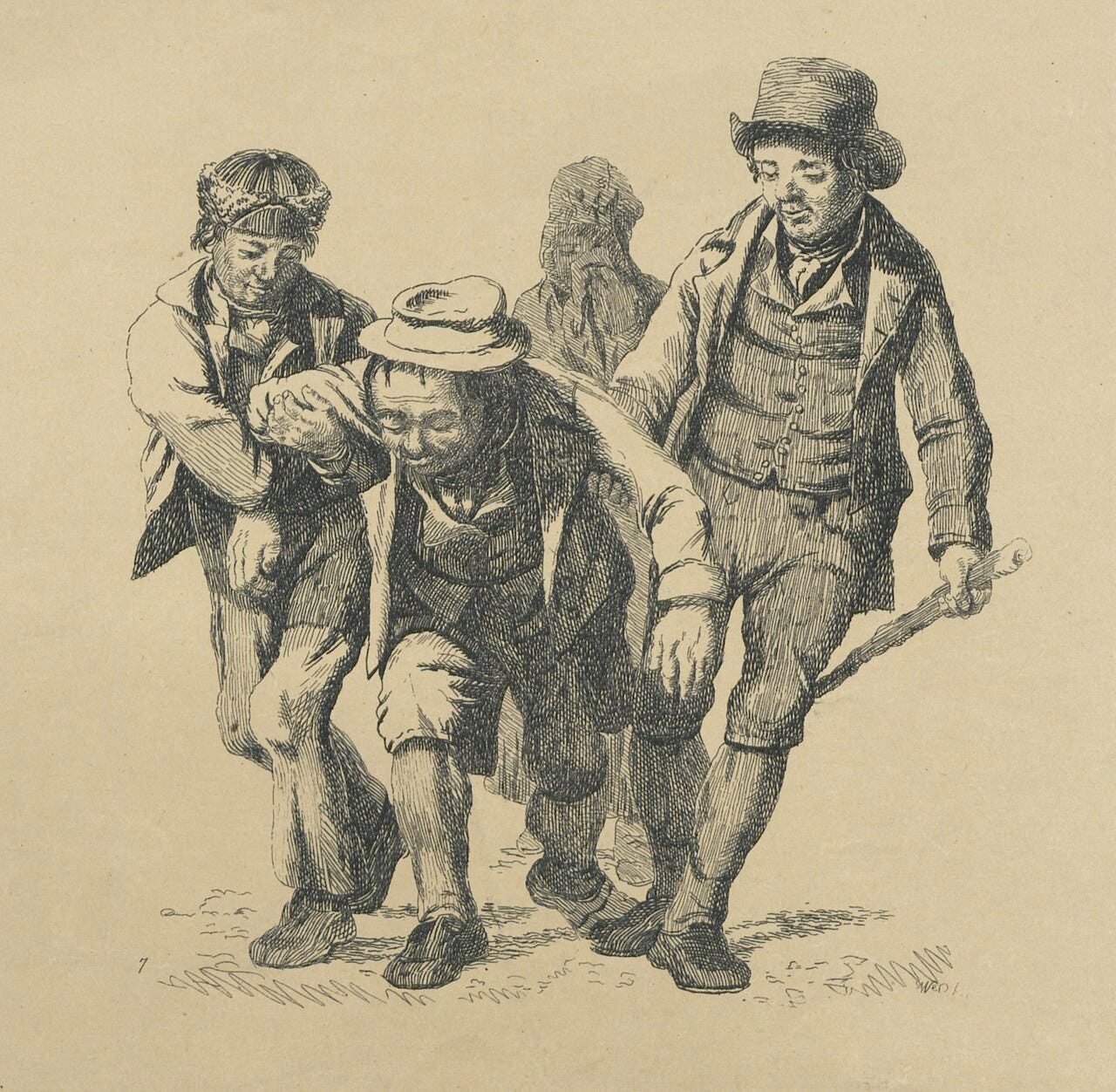
The image of two men dragging a drunk is by Walter Gelkie, before 1837.
Thank you again!🙏🙏🙏