
Touch your Face
The pageant and the procession and the display

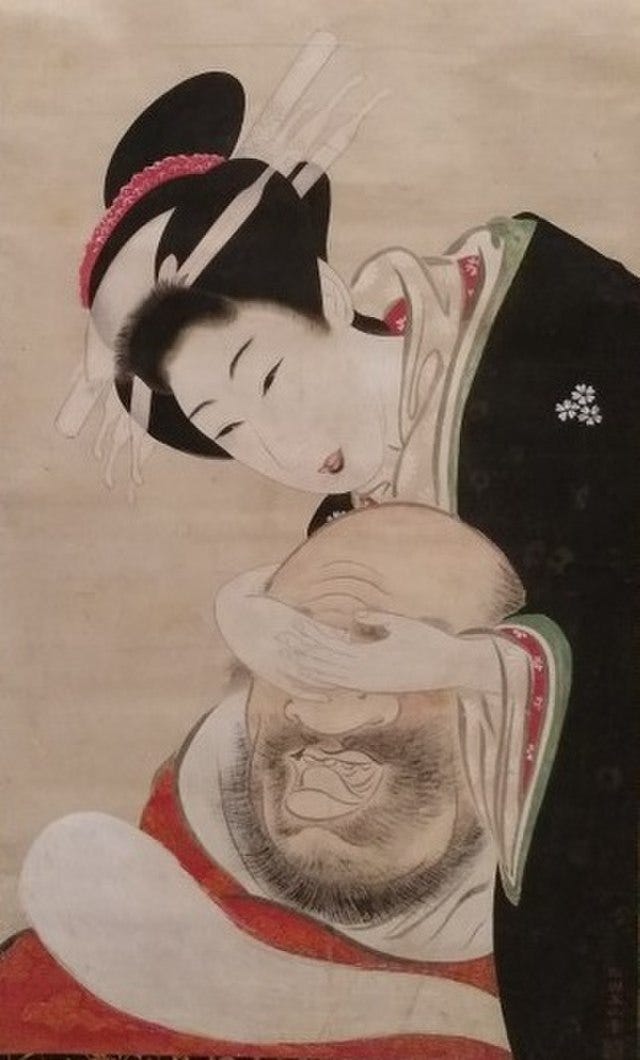
The master Huoan asked, “Why is it the Western Barbarian has no beard?”
Gateless Gate, case 4
The Western barbarian is not in itself a trick question. Most people with an interest in Zen know that’s Bodhidharma. Bodhidharma is the sometimes historic, more often mythical bringer of Zen to China from India. He is portrayed with bulging eyes, surrounded by bristling eyebrows, and, always, always, sporting a large and busy beard.
So, the matter turns on the beard that is no beard. And what that no beard might mean.
Here we come to something much like the Mu question with its overarching no. Not. Without. The great empty. A lacuna within our hearts. The great empty that is always known only in a specific. So beard and no beard.
The great American master of the intimate way Robert Aitken provides a commentary on this case quoting the poet Wallace Stevens.
His question is complete because it contains
His utmost statement. It is his own array.
His own pageant and procession and display.
There are so many thoughts that arise with the idea of a beard. For some it is a glory. For others it hides. Maybe the face. Maybe something else.
Another contemporary commentator the Zen teacher Guo Go reminds us, “Practice is for fools, but it is very important.” This reminds me of that term first coined by the apostle Paul, in his letter to the Corinthians speaking of “fools for Christ.” And after him the Desert fathers & mothers who were called holy fools. And, of course, Francis of Assisi, sometimes called God’s fool, and at other times the only Christian.
Corollaries of foolish wisdom pop up in the world’s faiths. The madzub, God-crazed saints in Sufism. And, of course, Hanshan and later Ikkyu as obvious examples within our Zen tradition.
The intimate way is a calling into a certain foolishness. The smart, the clever, see no gain in the intimate way. Well, other than for marketing. But then that Zen is cool and enigmatic. But the Zen of lived experience, the spiritual path, and intimate encounter, well, there’s truth to that being a kind of foolishness. After all, beards that are not beards?
One of my favorite historians Diarmaid MacCulloch in his the Reformation: A History observed how the new style preference of long bears among the Reformers underscored “a theological point that clergy were not a caste separate from the laity…” Didn’t hurt that it gave them a prophetic look, as well.
Of course there are the women and others without beards who understand this skin and hair. Don’t miss the true for the literal. Although we really do need to understand the literal. The bare face of it, if you will…
I like this case a lot. Just as I love our attempts at underscoring the complex identities of our humanity. And how in a last analysis it turns out we’re all one. Or, in Zen, empty. Beard? No beard? Which makes someone without a beard just as right. Of course.
Although even here, we need to remember the foolishness of the project. And, with that, we may find we’re all bearded ladies. Maybe we need to paste on a fake beard. Join the bearded chorus.
Or.
In Zen and other variations on the intimate way we are invited into something astonishing within all this foolishness. That beard, for one thing. That beard that is not, for another. And here in this little case, it’s all on display. The pointing. The disruption of our ideas of what are and are not. The invitation.
An invitation to the depths of our being. To what the Buddhists name Śūnyatā. May I be so bold and suggest it is also what some mean when they say God? The deep place in our hearts, the place behind every other place. But which can be found only in this place.
The place of our full surrender into grace.
And with tht the full presentation.
The words themselves are foolish. “Why is it the Western Barbarian has no beard?”
Well. As a practical matter just touch your face. What do you find? Is there a beard there or not? In Christ Jesus there is neither male nor female. The same in Zen. And yet, there we are. Men. Women. And various shades in between and beyond. Beard. No beard.
Why?
We are such foolish beings.
If the answer turns out to be yes, what does that mean? If no, that slippery word on our zen way, what does that mean? Are the answers different? Or the same? Like with answering the question of cause and effect. If we’re free of the matter, we’re reborn five hundred times. If' we’re bound, well, five hundred times.
Touch your face. Intimate, intimate.
When we throw ourselves into the project, what is it we find? What is the most intimate? Where do the wildly open and the most painful and beautiful eruption of the real meet?
Touch your face.
Dreams pile upon dreams, and we find ourselves presented with the simple truth. It contains words. It contains all the worlds. All we have to do, is let go.
The words are enough. A full pointing into the matter.
Our faces are enough. Yours. Mine.
Just that. Just this.
The pageant and the procession and the display.
Not one. Not two.
Touch your face.
A woman blindfolds Bodhidharma, Ishida Guokuzan, late Edo period (early 19th to early 20th century