
Centering Prayer
East meets West and a Spiritual Practice is born

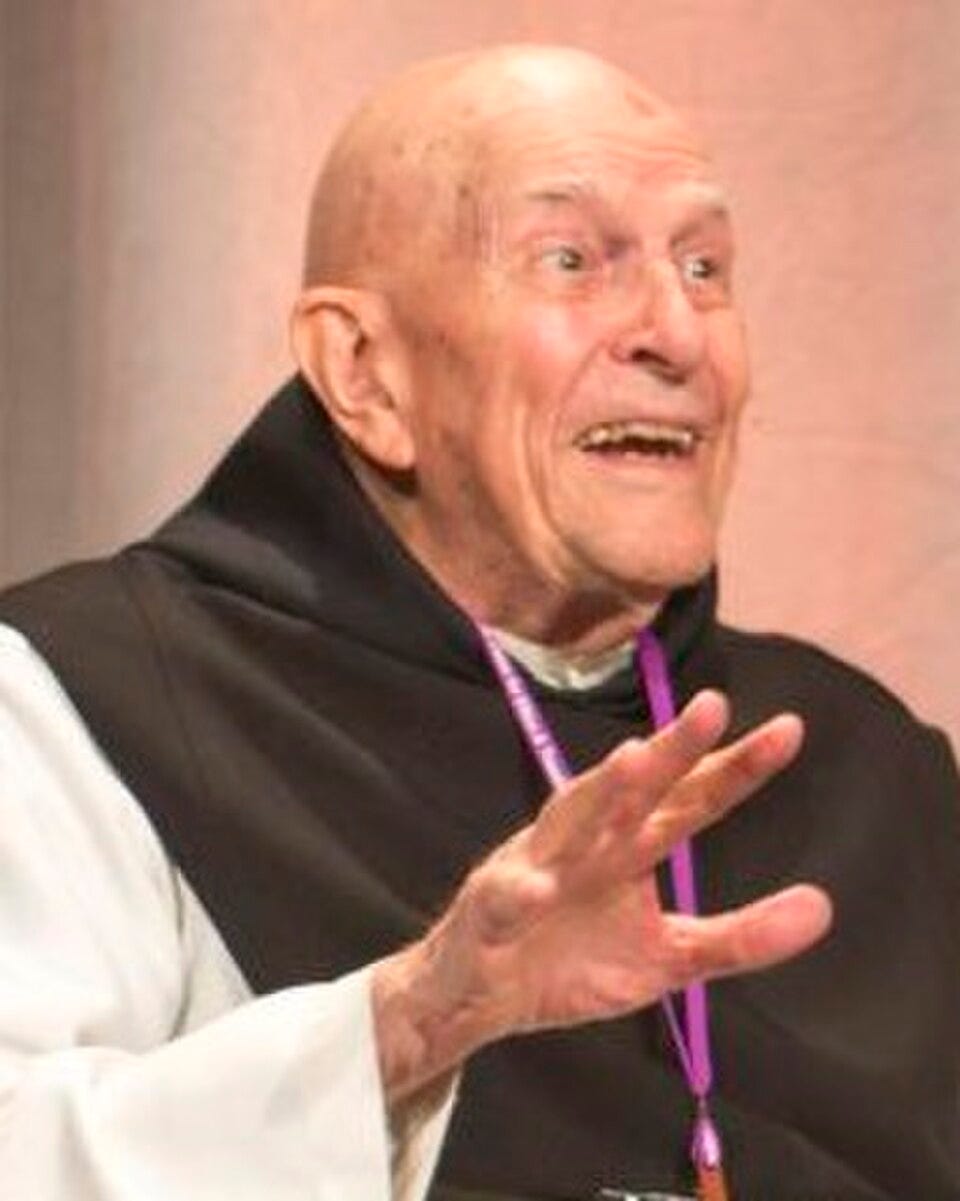
There’s a story I’ve heard in several versions. The thread to them all is that a spiritual pilgrim, or maybe its two, find themselves at the gate of St Joseph’s Abbey, a Trappist monastery in central Massachusetts. They’re greeted by a monk. The pilgrim or pilgrims apologize and say they’re trying to find the Insight Meditation Center. It’s also in central Massachusetts, about eighteen miles away from the abbey.
The monk, in most versions its Father Thomas Keating, explains the way to the center. And then says, “You know, you can find something quite similar within your Western tradition.” If they were intrigued, he told them about Centering Prayer.
Many people attribute the inspiration for this discipline to something another Trappist, Fr Thomas Merton wrote in a letter to the Sufi scholar Abdul Aziz.
“Now you ask about my method of meditation. Strictly speaking I have a very simple way of prayer. It is centered entirely on attention to the presence of God and to His will and His love. That is to say that it is centered on faith by which alone we can know the presence of God.”
That line “centered entirely on attention to the presence of God” gives the discipline Fr Keating was referring to its name, Centering Prayer.
The practice may have been inspired by Thomas Merton, but St Joseph’s Abbey is where it formed. And three of the abbey’s monks, Fathers Keating, William Meninger, and Basil Pennington gave it shape and taught it to the first generation of practitioners.
In the 1960s the abbey was a particularly innovative spiritual community. The monastery was rooted in the disciplines of the Order of Cistercians of the Strict Observance, itself a reform of the Benedictine Order. They are best known as Trappists, the stricter of the two Cistercian Orders. They all follow St Benedict’s rule, which was written in 530. Their motto, what today we might call a mission statement was “Ora et labora,” “Pray and work.” So, ancient and deeply committed to the ways of contemplative life.
While St Joseph’s was founded in 1950, the community that founded it was originally formed in 1825 in Nova Scotia. Then, after some years in Rhode Island, they found their permanent home in Spencer, Massachusetts.
Thomas Keating was elected the second abbot of the community at its Spencer location, serving there from 1961 through 1981. During these years the monks were inspired by the Second Vatican council’s throwing open the doors, and like Thomas Merton found themselves ready to learn from wherever the spirit seemed to rest. They hosted interfaith and inter-monastic conferences, and invited dialogues with both Hindu and Buddhist teachers. At least one monk practiced Transcendental meditation. The Rinzai Zen abbot Joshu Sasaki once led a full seven-day Zen retreat there.
And in this fertile moment Fathers Keating, Meninger, and Pennington led a revival of Christian meditative disciplines inspired by Eastern traditions, but completely Christian. Their abbot Thomas Keating came from a patrician New York background. He was born in 1923, educated at Yale and Fordham, he entered the monastic life in 1944. Keating has been called the intellectual architect of Centering Prayer. It was he who put the call out to his community.
“Could we put the Christian tradition into a form that would be accessible to people… who have been instructed in an Eastern technique and might be inspired to return to their Christian roots if they knew there was something similar in the Christian tradition?”
The actual developer of the practice, who created the broad outlines of the discipline was Fr William Meninger. He was born in Malden, Massachusetts, in 1932. His mother was from Ireland, his father a Quaker. Meninger was a priest serving first among Native Americans and then with Mexican migrant workers before entering the abbey in 1963.
Using the Cloud of Unknowing as his textbook, Fr Meninger outlined a course in contemplative practice. He practiced it himself, and he taught others, individually and in workshops. At first, he called this practice, “The Prayer of the Cloud.” Among the many places one could legitimately say the Centering Prayer movement began, this is a good one.
Basil Pennington is the third founding figure of the Centering Prayer. Born in Queens, New York in 1931. In 1951, one year after graduating from college he entered the abbey. They sent him to Rome to study at the University of St Thomas Aquinus and the Gregorian University. His interests in contemplative practices included a stay at Mt Athos, and with Father Bede Griffiths in India.
He was the most important popularizer of Centering Prayer. He gave lectures and led workshops across the country and around the world. Fr Pennington wrote 57 books and numerous articles. His book Centering Prayer has sold more than a million copies and has not yet gone out of print.
The practice of centering prayer is deceptively simple.
There are four steps. I’ve seen a couple of versions, all very close. This is how the Reverend Cynthia Bourgeault presents them.
“1. Choose a sacred word as the symbol of your intention to consent to God’s presence and action within. 2. Sitting comfortably and with eyes closed, settle briefly and silently introduce the sacred word as the symbol of your consent to God’s presence and action within. 3. When engaged with thoughts return ever so gently to the sacred word. 4. At the end of the prayer period, remain in silence with eyes closed for a couple of minutes.”
To expand upon this, just a little. First, following the guidance in the Cloud of Unknowing, you select a “sacred word.” These are usually one or two syllables. “God” and “Love” were options suggested by the author of the Cloud. Other words commonly used in Centering Prayer include “Mother,” “Jesus,” “Mary,” and “Peace.” This just begins the list. There are many more that could work.
Sit comfortably. Close your eyes. Begin using the sacred word to signal your intention to be present to God. The sacred word is not meant to be repeated in the manner of a mantra. Rather it’s a touchstone into silence and presence. Think of it as an anchor to return to when thoughts wander. As they will.
The typical period for the practice is twenty to thirty minutes. If you’re beginning to practice the Prayer, five or ten minutes might be a good idea. As in Zen, and all authentic spiritual practices, regularity is more important than duration. Using a timer is recommended.
The actual practice is resting your mind and your body in the presence of God.
An interesting pointer for this is to imagine what you’re doing as a kind of receptivity. Sometimes the word “consent” is used for the proper attitude undertaking this practice, as in consenting to the presence of God, who is always there. Here. Waiting in love.
Father Keating says, “Let go of every kind of thought during prayer, even the most devout thought.” And when the mind wanders, as you notice, don’t judge or fall into the trap of analysis, why you were distracted, or following the content of the distraction or the why of it. Use the sacred word to gently return.
When the timer goes off, don’t immediately get up. Rest in that moment for a few heartbeats.
This just gives a little more structure to the practice offered in the Cloud of Unknowing. It’s an expression of the apophatic tradition, the via negativa. Rather than looking for God in things, in the rites, in the images, in the concepts, God is found through letting go of all these things. Ultimately, it’s not anything more than accepting the grace that is already infusing the world.
The recommended schedule is half an hour, twice a day. Mostly it’s practiced in small groups meeting at churches or in people’s homes.
Simple. And yet, it can be powerful.
This practice hasn’t received universal acclaim within Catholic circles. Conservatives have asserted Centering Prayer is really crypto-Buddhist. Or that it’s derived from Transcendental Meditation. It’s said how the Prayer deviates from authentic Christian prayer by bypassing the person of Christ. There are also disputes as to whether it actually is prayer, and whether Centering Prayer is really a form of meditation that simply has been rebranded.
Father Keating had been abbot for twenty years at St Joseph’s when some unrest came to a head. The unrest was mainly initiated in large part by his prominent advocacy for Centering Prayer and the amount of time he devoted to propagating it. The vote was equally divided, half in favor of his continuing, half not wanting him to serve any longer as their abbot. He resigned the office rather than lead a divided community.
All that said, it looks like at least for now Centering Prayer has a life. People like former Trappist monk James Finley who finds this practice bridges Christian contemplation and depth psychology. Others, like the Franciscan friar Richard Rohr, whose Daily Meditations has millions of subscribers, and the Episcopal priest Cynthia Bourgeault, have continued to present the practices to people seeking a Western contemplative practice. And each of them finding receptive ears.
Reverend Bourgeault in particular has deepened the theological understanding of the practice. She expands on the idea of kenosis, the self-emptying of God and the individual as expressions of nonduality. She also sees this emerging practice at once very old and just right for our more cosmopolitan sense of the spiritual life stands firmly within the perennialist movement.
The founders have now all died. Father Keating in 2018, Father Meninger in 2021, and Father Pennington in 2005.
The practice was first offered outside of St Joseph’s in 1983, when Fr Keating led the first Centering Prayer retreat at the Lama Foundation, in San Cristobal, New Mexico. Several participants in that retreat formed a group to support the practice. They organized as Contemplative Outreach in 1984. It remains the principal organization supporting Center Prayer as an ongoing practice.
Participants in that same retreat created in a live-in community in 1985. It was led by Mary Mrozowski and named Chrysalis House. It began in West Cornwall, Connecticut and then next year it moved to Warwick, New York. It lasted until Mrozowski’s death in 1993. While the House disbanded following her death, many of today’s leaders of the Centering Prayer movement began at workshops they led.
The movement remains loosely connected through Contemplative Outreach, but while also remaining connected to the Catholic Church it has practitioners and groups nested in many churches of many denominations.
A general summation of the Centering Prayer is that it births in an interfaith moment and continues as a spiritual bridge between East and West. Centering Prayer offers a somewhat stripped-down, mindfulness-like approach to meditation that resonates with Eastern, and especially Buddhist practitioners, while remaining explicitly Christian.
Increasing numbers of Christians, including a number who had wandered to Eastern traditions, are finding it a grounding to their ongoing spiritual lives.
Worth knowing about…
The image is of Father Thomas Keating
Centering Prayer has never struck me as a dialogue with the Word made Flesh, of conforming ourselves to the divine nature in Him, through Him, and for Him. Its methodology strikes me as a pursuit of feelings and states and not true contemplation.
I had lots of responses to this, too many to write in a comment. Thank you for this concise history.